
Logan and Albert Conservation Association
 Loganlea to Jimboomba network upgrade information is available on the Energex website here. Some individual landowners whose properties have been identified as being affected have been contacted by Energex.
However these concerned citizens are aware that there are far wider implications than a 40 metre easement across their land which is adjacent to the Logan River.
Given the current situation re environmental impacts of our traditional energy supplies, would we - the community, city and country - be better served by future investment being channeled to renewable sources and also targeting new growth areas for urban and industrial footprint expansion to be self contained and independantly energy sufficient?
Should this whole issue be debated openly before a corridor option is chosen by Energex? When do we review our comfortable ways of considering progress? Is more of the same what we want?
Local Logan Reserve resident Dieter Lacko was interviwed by Henry Tuttiett of the Jimboomba Times - the story was published 17 December 2008. Over 40 local residents gathered to discuss their concerns and how they could best resolve these. Unfortunately neither Cr Phil Pigeon
Energex says that residential and commercial growth in South East Queensland and an increased demand for energy has led to a sharp rise in electricity consumption. As a result, the region's existing electricity supply is reaching capacity.
To meet increased demand, ENERGEX has embarked on a five year, $4 billion investment program across South East Queensland. This investment will reinforce the network and provide a more reliable and safe supply of electricity to residents and businesses.
Energex and Powerlink are not private companies: they are branches of Queensland government - this is a government service infrastructure. There is a Minister for Mines and Energy Mr Geoff Wilson.
It is proposed that Logan, one of the region's fastest growing areas, should benefit from this investment program. Neither Loganlea nor Jimboomba is a rapid growth area - see Draft SEQ Regional plan. Visit http://www.dip.qld.gov.au/regional-planning/draft-regional-plan-2009-2031.html.
South East Queensland Infrastructure Plan and Program [SEQIPP] needs to be read in conjunction with SEQRP.
The South East Queensland Infrastructure Plan and Program 2008-2026 outlines the government's infrastructure priorities for the South East Queensland (SEQ) region to support the SEQ Regional Plan. It represents a long-term commitment to infrastructure delivery in SEQ.
The SEQ Infrastructure Plan was first released in 2005 and is updated annually to reflect and align with the latest planning and budget commitments. It sets timeframes and budgets to ensure infrastructure is delivered to support the region's growth.
The 2008 edition of the plan details around 300 identifiable projects, with an investment of just over $107 billion (inclusive of federal government contributions and other revenue sources):
$83.5 billion in road, rail and public transport
$8 billion in water
$3.5 billion in energy networks
$12 billion in social and community infrastructure.
Of particular note is the chapter on energy available as 11 page pdf file from the main page link above.
 Kilowatt Ours is creating a network of homeowners and renters in America dedicated to striving for Net-Zero energy usage in their homes and apartments. Kilowatt Ours is the story of filmmaker and conservationist Jeff Barrie's 18-month journey across the southeastern U.S. to document energy-related problems and present practical, cost-saving solutions for consumers. Widespread problems revealed in Kilowatt Ours include mountaintop removal, air pollution, global warming, childhood asthma, and mercury contamination.
The film Kilowatt Ours shows the city of Austin as they built what they call an "energy conservation power plant." Rather than build a new coal-fired power plant, the community decided it was a priority to advocate aggressive energy conservation efforts instead. After 20 years, Austin now saves more than 600 megawatts of electricity every day - one power plant worth of electricity, generated strictly from energy savings. Here is a link to watch a short clip from Kilowatt Ours, featuring this initiative.
 "The Story of Stuff " is a highly informative and entertaining web video that documents the destructive impacts of consumerism and waste. The video features American activist Annie Leonard taking viewers through the process of creating a consumer good - from the extraction of materials to the disposal.
Topics discussed include materials economy, linear systems, the golden arrow of consumption, wealthy corporations, the role of government, toxics, human breast milk, toxic waste. Check it out but beware: Your trash will never look the same.
This is the full version however you can select other links to view it in chapters.
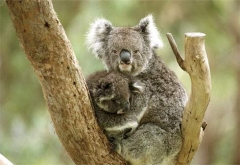 Scientists and researchers from Queensland University and from Queensland University of Technology are trying to learn more about koalas' breeding habits by listening to the animals' bellows. Mobile phones and GPS collars are being used. This study was reported by National Geographic. The brief news clip with male koala vocalisations is available here.
Meanwhile concerned citizens fear for the long term survival of koalas in their natural environment. Debbie Tabart from the Australian Koala Fountation is featured on this video advocating for a National Koala Plan.
 Ignoring calls for strong action on climate change, the Federal Government has announced its plan to cut carbon pollution by just 5% (increasing this to 15% only if other major polluters commit to a global agreement).
Let the Government know that this decision is unacceptable.
This decision does not place Australia in a position to save the Murray-Darling Basin, the Great Barrier Reef or the Australian Alps. Instead, it will hold back progress towards an effective international climate change agreement.
The Government has disregarded the advice of top scientists from the Intergovernmental Panel on Climate Change (IPCC) - that state that developed countries, as a group, must reduce their carbon pollution by 25-40% - and community support for greater action on climate change.
What's more, the plan will see billions of taxpayers' dollars handed directly to big polluters. However, this is not the final word. Let the Government know that this decision is unacceptable and must be revisited via the media and your local MP.
Visit the Australian Conservation Foundation website for tips on what to do.
BEST THINGS YOU CAN DO RIGHT NOW!
VISIT YOUR MP
WRITE TO A PAPER
CALL TALKBACK RADIO
Contact or email your friends and family, encourage them to make their voice heard too. Download the community action kit [26 p 2.69 MB pdf] from this page
To avoid dangerous climate change, and give our icons a fighting chance, we must commit to reducing our carbon pollution by at least a third by 2020.
 Some of these online polls are still accepting votes.
See:
The Australian Online Poll on the target at - http://www.theaustralian.news.com.au/story/0,25197,22073824-5013404,00.html
The Age Online Poll on the Target at - http://www.theage.com.au/polls/form.html
The Canberra Times Online Poll on the target -- http://www.canberratimes.com.au/polls/
The Western Austarlian - Do the Carbon Cuts go far enough Poll? at. http://www.thewest.com.au/ (Scroll half way down the cover page)
There may be new polls you'd like to follow eg The Australian's poll, at time of editing concerns, the Christmas shopping dollar.
 The Queensland government long term planning strategy for protecting koala habitat values through planning and development process is the establishment of a new Koala State Planning Policy in 2009.
The finalisation of the mapping and a new Koala State Planning Policy will, we hope, help determine the appropriate protection mechanisms to ensure the long term protection of koalas in SEQ. The timing of this work will also allow the outcomes to be considered in the final SEQ Regional Plan 2009-2031 in July 2009. The draft SEQ Regional Plan 2009-2031 is open for submissions from December 2008 to 3 April 2009.
Draft SEQ Koala State planning regulatory provisions can be downloaded here.
Submissions close 27 February 2009
 The draft South East Queensland Koala State Planning Regulatory Provisions came into effect on 12 December 2008. The Department of Infrastructure and Planning is now the concurrence agency under the Integrated Planning Act 1997 for defined development in Urban Koala Areas and in Koala Sustainability Areas that are within the Urban Footprint as defined in the South East Queensland Regional Plan 2005-2026.
You can download a copy of draft SEQ Koala SPRP from this page 128kb pdf and copies of regulatory maps are here. Unfortunately there is no mapping - and no protection for country Logan (former Beaudesert Shire) and Scenic Rim areas. A list of future growth areas includes Bahrs Scrub, Beaudesert, Bromelton, Canungra, Flagstone, Greenbank, Park Ridge, and Yarrabilba - none of them mapped ie with some protection.
 The draft SEQ Regional Plan and the draft state planning regulatory provisions are open for submissions from December 2008 to
3 April 2009. After a review of the submissions, an updated SEQ Regional Plan will be finalised in July 2009. Documents are available on the government website.
All land in the region is divided into three regional land use categories Regional landscape and rural production area, Urban footprint and Rural living area. The plan is designed to deliver land for urban growth - with urban growth areas, future growth areas and identified growth areas.
You can find out which land use category applies to a property in the region by using the interactive mapping tool.
Explore the Department of Infrastrucure and Planning website for full details. More information will be extracted from government or council sites and posted here soon that relates to Logan and Scenic Rim areas. Please contact us if you would like help to make a submission.
If you are concerned for the longterm survival of Queensland's flora and fauna, their habitat and ours, please read these government documents and have a say. NOW EXTENDED UNTIL 1 MAY 2009
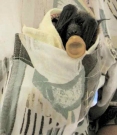 Trixie tells of her recent visit to a dedicated team of wildlife carers at Canungra where baby bats rest in shirt pockets where their progress is monitored.
Canungra Camp - 24 November 2008
Cruising south bound towards the Gold Coast Hinterland where Trish's property is located one could not help but notice how the landscape had been transformed. From parched brown to lush green: a sight not seen for a very, very long time, thanks to the heavy but welcomed constant rainfalls over the past couple of weeks.
We ascended Trish's steep winding driveway that lead us to her home nestled high in the hills. As Paulette and I emerged from the car I took in the sight of Trish's acreage with its rolling hills and deep valleys. My first visit was filled with images of tall mature trees, water filled dams and the collective sounds of the wildlife. I could hear the distant calls of the currawongs, the crack of the whipbirds echoed in the hills, the familiar sounds of squabbling lorikeets and figbirds raiding fruit bearing trees. The land had a serene feel but within the walls of Trish's home a completely different story was exposed.
 As I stepped through the front door of Trish's the atmosphere inside was a far cry from what I had witnessed outside only moments before. Slouched in chairs were half a dozen bat carers with a new batch of babies that required their 3-hourly feeds. Babies lay on laps, cradled in arms and smaller ones were tucked into large pocket shirts.
These carers had been feeding throughout the night to meet the demands of their charges. Exhaustion had set in but there were still lots and lots of mouths to feed and the carers knew that only too well.
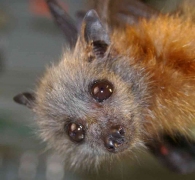
A little background history...As a matter of routine the Canungra Flying Fox colony was being checked out when a discovery was made - a drama that no one could have envisaged had unfolded. It is not uncommon to rescue a handful of baby flying foxes during the breeding season but when you are alerted to over three hundred starving, dying and dead babies of the vulnerable listed Grey Headed Flying Fox being abandoned by their mums it raises a grave concern. The Canungra Camp was in serious, serious trouble.